



Danil Kislinskiy
Some founders may believe their vision will enthrall the investors so much that they’ll look past any kind of investment criteria.
Unfortunately, that is not the case as most VCs practice smart investing based on their fund’s investment thesis and chosen strategies.
Understanding the principles of investor decision-making is a crucial element of entrepreneurship.
Balancing Risk and Reward
It is known that 65% of venture capital deals return less than was invested in them. So VCs have their work cut out for them. How do they manage in such dire circumstances?
Henry Kravis, a renowned venture capitalist, recommends carefully evaluating potential losses and achieving an optimal risk-reward tradeoff by:
● Conducting thorough due diligence
● Building a diverse portfolio
● Actively managing investments
● Staying informed about market trends
● Carefully planning exit strategies.
Focus vs diversification
By diversifying their portfolio while, at the same time, staying true to their investment thesis, VCs can greatly minimize their losses.
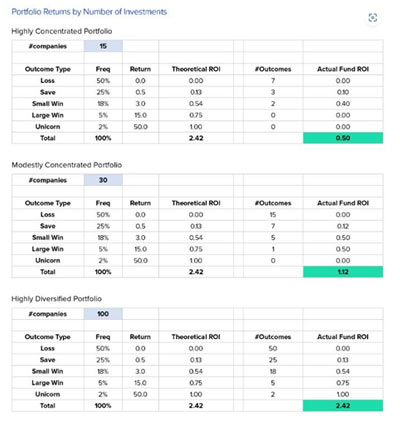
A calculated and focused approach is surely a robust strategy in the hands of an investment guru. However, data gathered by Toptal shows that a diversified portfolio can seriously juice up the returns:
 Sector diversification
Specializing in sectors such as SaaS technology, biotechnology, or AI tech grants VCs an in-depth expertise in these fields. It allows them to be more involved in key decision-making of their portfolio companies.
However, this approach also makes them vulnerable to market fluctuations. To spread their investment risk and widen their pool of opportunities, VCs often aim to create a varied portfolio of startups.
Stage diversification
By diversifying their portfolio via investing at differing stages in a startup’s cycle, investors can reduce the risks of exiting during unfavorable market conditions.
Stage diversification also improves the firm’s deal flow and helps VC managers achieve greater success in exits via IPOs and M&A.
Geographic diversification
A narrow geographic scope becomes a great threat when facing unexpected challenges, such as political instability or economic pressure.
To counter this, VCs scout globally for prospects in emerging markets with untapped potential and rapid growth rates.
Investment strategies for countering risks
To maximize the potential of a diversified portfolio strategy and minimize risks, investors use the following tactics:
"If an investor’s decision depends on two factors, namely the startup idea and the team’s strength, the focus should be on evaluating the team first"
● Syndicate investing: when multiple investors pool their resources to collectively invest in a startup.
● Defensive investing: VCs invest in sectors that are less susceptible to economic downturns: healthcare, consumer products, essential services, etc.
● Hedging: investing in assets that move contrarily to the broader market: options, futures contracts, and inverse exchange-traded funds (ETFs).
Top-down investing
Top-down investment entails betting on startups based on a broader macroeconomic trend.
According to Mick Heyman, an independent financial advisor at Heyman Investment Counseling:
The great advantage of top-down is that you’re looking at the forest rather than the trees.
Bottom-up investing
Contrary to the previous approach, a bottom-up investing strategy involves VCs basing their decisions on the strength of an individual company.
A powerful investor can find great opportunities even in the most out-of-favor industries. This tactic particularly suits those who prefer to go about investment through research and diligence.
The importance of doubling down
A company worth funding usually merits several rounds of investment from an interested fund, since betting more money on good prospects gains better returns compared to single and minor investments.
Managing Partner at Union Square Ventures, Fred Wilson, gives his point of view on why reserving for follow-on investments is important:
One of the most common mistakes I see new emerging VC managers make is that they don’t sufficiently reserve for follow-on investments. They put too many companies into a portfolio and they can’t support them all.
Most importantly: focus on finding the right teams
If an investor’s decision depends on two factors, namely the startup idea and the team’s strength, the focus should be on evaluating the team first.
Apple and Intel's early investor Arthur Rock, crowned "Silicon Valley's Unmoved Mover", solidifies the point perfectly:
Ideas are more malleable than people. Someone’s personality is far harder to change than executing a product pivot. The vision and talent of a founder is the drive behind everything in the company and, in these days of celebrity founders, it is also a branding exercise.
An effective VC investment strategy involves balancing risk and reward by identifying high-potential startups, diversifying the portfolio across sectors, stages, and locales, communicating and monitoring performance, and navigating exit strategies.
